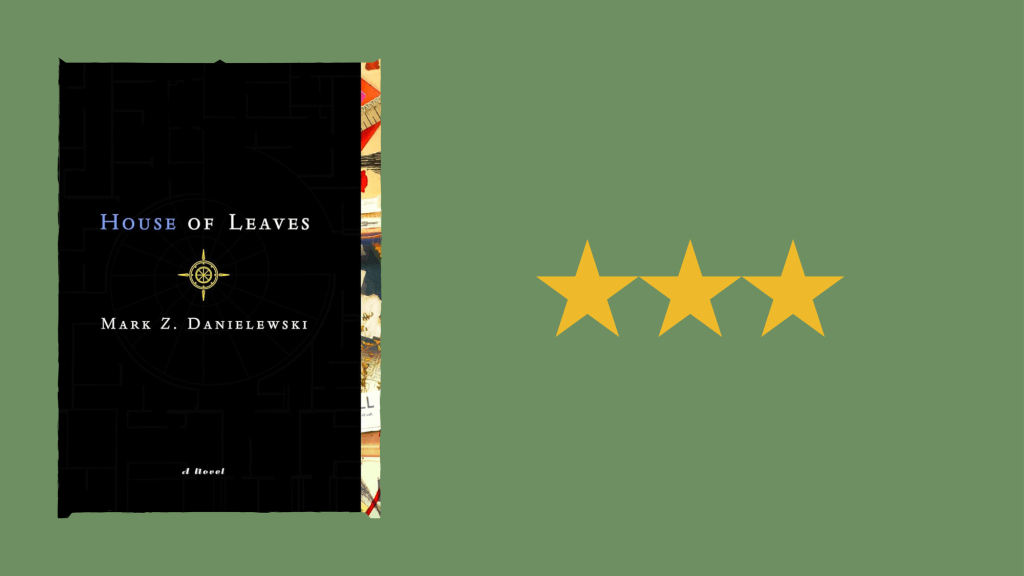
There’s no denying that “House of Leaves” is a singular experience. From the first pages, the novel throws you into a disorienting rabbit hole: a book about a man compiling notes about a documentary that may or may not exist, centering on a house that seems to exist beyond the laws of nature. It’s a fascinating yet maddening premise, and it’s no surprise this book has been said to drive people crazy. And it WORKS, especially at the start. The mystery of the Navidson Record immediately draws you in, and the book’s layered format — stories within stories, footnotes within footnotes, referencing sources that don’t exist — builds an unsettling tension that makes the house’s growing horrors all the more effective.
This was a very difficult read, to say the very least. Its formatting is intentionally chaotic — if anyone has read it in digital format, will you let me know how that translates? — pages printed upside down, sideways, in spirals, or with only a few words at a time. While this contributes to the realism, making it feel like a genuine compilation of fragmented, unstable source material, it also interrupts the flow and can be downright exhausting. I still don’t know why the word “house” was always printed in blue, and I’m not sure that mystery adds much after awhile.
The Navidson house storyline is GENUINELY creepy, and seems exactly like a found-footage horror film that would end up becoming one of my favorites; with its subtle, skin-crawling moments: a closet that suddenly appears, impossible measurements that don’t add up, and a growing sense of dread that pulls the reader under alongside the characters. That was the strongest part for me. On the other hand, Johnny Truant’s footnotes, the ones filled with drug-fueled spirals, unhinged paranoia, and sexually explicit obsessions, felt more like a chaotic sideshow. While they do serve a purpose (adding to the realism and showing his mental unraveling), they didn’t grip me the same way. The monsters in Truant’s world felt less defined and more like noise, haunting-adjacent static.
Ultimately, I respect what this book set out to do. It’s ambitious, experimental, and deeply unsettling in all the right places. But it’s also dense, confusing at times, and too fragmented to fully land emotionally. I’m glad I read it, but I wouldn’t rush to revisit the house anytime soon.
 WeaveReads
Leave a comment