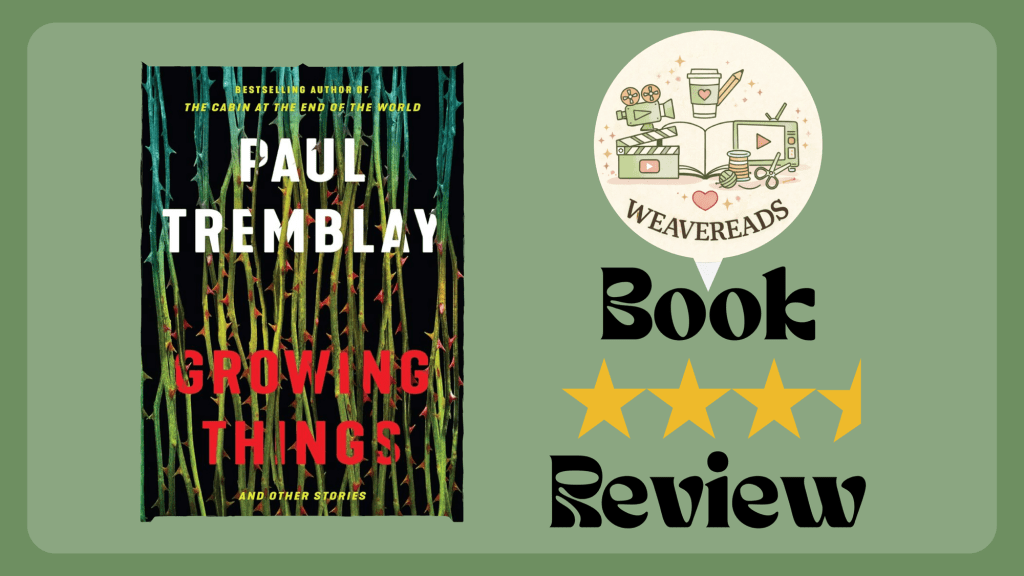
Paul Tremblay’s short story anthology “Growing Things” starts strong and immediately reminds me why his writing always takes a second to fully settle into my brain. Seeing as there were 19 stories in this collection, my review will focus on my favorites, but my overall rating is for the book as a whole.
The title story “Growing Things” is quiet in that deeply unsettling way that Tremblay does so well. In just a few pages, Merry casually mentions that she barely remembers her mother, who ran off when she was four, yet clearly remembers a preacher who had been intermittently in her life around the same time. That detail stuck with me more than anything else. It felt like such a sharp observation about memory and absence; how we assume the people that are supposed to be there will always be there, so we don’t bother etching their memory in our minds until it’s too late. Marjorie, meanwhile, fully embraces the role of unsettling older sister, drifting from eerie to almost comatose in a way that’s genuinely uncomfortable to see unfold.
I loved the concept here: un unstoppable, unknown force of “growing things” that can punch through manmade structures and and render humanity useless. But I won’t lie, I walked away feeling a little lost. I couldn’t tell if the story was smarter than me or if I just wanted a little more payoff. The ambiguity is intentional, obviously, but it still felt anticlimactic for how strong the premise was.
“Swim Wants to Know if it’s as Bad as Swim Thinks” surprised me, because I usually don’t vibe with first-person POV in horror (or any genre, really). I don’t like being shoved directly into the situation. But this one works, because it isn’t about immersion — it’s about a mind fracture in real time. The way the narrator’s thoughts loop, diminish, contradict themselves, and rewrite reality is genuinely fascinating. It becomes clear pretty quickly that she did something horrible involving her daughter, lost custody, and isn’t allowed anywhere near her… and the story absolutely dangles that question in front of you like bait. WHAT did she do??? Oh, and apparently there are monsters coming out of the ocean, but that’s… lesser news, somehow. The narrator is deeply unreliable, manipulative, and still somehow calculating despite nearly unraveling, and while the ending twist comes fast, it was worth it. Expected, but effective.
“Something About Birds” fully sent me into WHAT IS HAPPENING territory. I don’t care how popular or respected Wheatley is, if someone gifted me a bird head, we’d be done. The moment that thing either grew or got replaced by some disturbingly realistic, fleshy bird mask, I was locked in. And then suddenly we’re dealing with what feels like a full-blown bird cult — torture, ritual, sacrifice — possibly all because of a poem? Or because Wheatley initiated something? I have so many unanswered questions, and while that’s kind of the point, it left me spinning.
“Nineteen Snapshots of Dennisport” might be one of my favorites purely because of its structure. A narrator describing numbered photographs, revealing bits of their life through frozen moments, immediately worked for me. I was fully convinced this was headed toward an affair or a crime-of-passion moment, but the twist caught me off guard (in a good way!) I still wanted more (I always do with short stories), but I loved that it went somewhere darker and colder, especially with the narrator quietly setting up revenge.
And then there’s “A Haunted House is a Wheel Upon Which Some Are Broken,” which I adored. An interactive story?? Immediate yes. I stopped taking notes because I was having too much fun. The repetition works beautifully here, and by the end, it becomes this really powerful meditation on grief, loss, and the slow painful movement towards acceptance.
All of the stories orbit similar themes: fractured minds, unreliable narrators, quiet apocalypses, and the monsters we agree to live with. Some landed better than others, some left me frustrated, and a few genuinely impressed me. Overall this ended up being a 3.5-star read for me (rounded up for 4 stars), for being messy, confusing, thought-provoking, and just very Tremblay.
 WeaveReads
Leave a comment