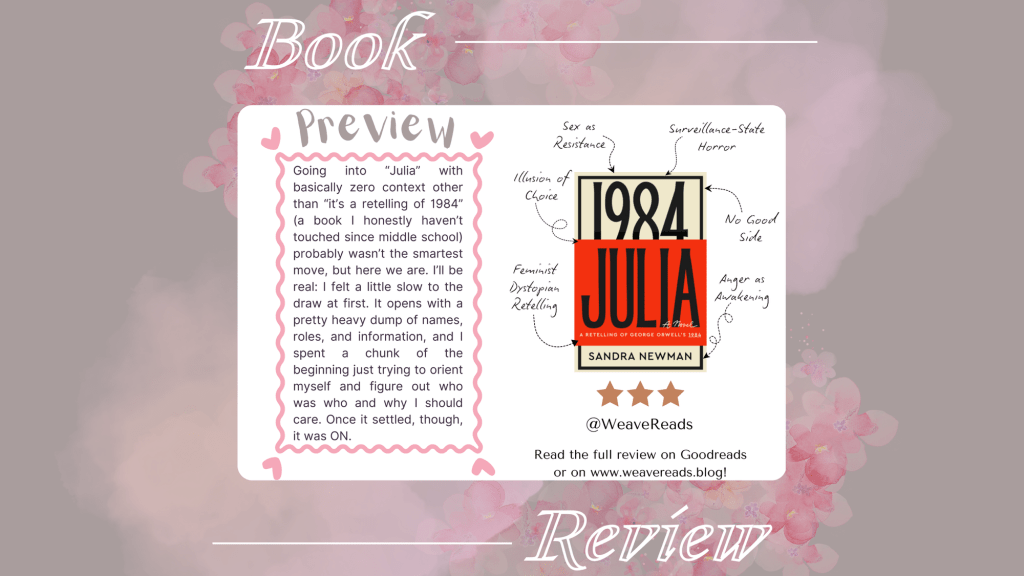
Going into “Julia” with basically zero context other than “it’s a retelling of 1984” (a book I honestly haven’t touched since middle school) probably wasn’t the smartest move, but here we are. I’ll be real: I felt a little slow to the draw at first. It opens with a pretty heavy dump of names, roles, and information, and I spent a chunk of the beginning just trying to orient myself and figure out who was who and why I should care. Once it settled, though, it was ON.
Because holy sh*t — that moment with the baby. I genuinely did not see that coming. Was it a miscarriage? A purposeful abortion? Some faceless culprit leaving it for Julia to find? That whole sequence completely knocked the wind out of me. From then on, this books became one of those reads where taking notes almost feels pointless because everything is so mentally involving. So much is constantly happening that I just wanted to keep going and find out what fresh horror was waiting on the next page. (And, refreshingly, a different type of horror than I’m used to!)
The way Julia is interrogated after reporting the baby is infuriating. The immediate suspicion, the way she’s treated as guilty no matter how much she denies involvement — it perfectly captures that “guilty until proven innocent” nightmare of a society. And then somehow… Vicky (the aforementioned culprit) is just fine? Or at least not exiled, silencer, or erased? Even if her protection comes from engaging with someone higher up, the lack of consequences felt bizarre and confusing. The rules of this society are so murky: where is the cutoff for punishment, exactly? Who gets spared and why?
Julia’s whole arc with O’Brien stressed me out to no end. She keeps getting summoned to meet him and puts it off or delegates, and all I could think was: isn’t that more suspicious than just going and getting it over with? I didn’t fully understand the hesitation beyond his Inner Party status, but everything about him felt suffocating and wrong in a very intentional way. Same with the class dynamics; Julia getting attacked by people lower than the Outer Party and then having to hide it confused me. She’s technically above them, so why is she the one afraid of the consequences? The power structure seems deliberately skewed and disorienting, which I get is the point, but it still left me frustrated.
Also: the way this book handled women made my blood boil, which again, is very much the point. Even in a society where everyone is oppressed, women are still treated worse. The constant predation. The lack of agency. Winston insisting Julia accompany him places she doesn’t want to go. I just cannot find it in myself to like a single man in this book. Let the women breathe. Let them THRIVE. Vicky wanting to be a nurse and still being surrounded by creep-o men made me want to scream.
Julia’s skewed understanding of sex and relationships is fascinating and horrifying. Her willingness to treat herself as disposable, to sleep with men in her department as a form of resistance or information-gathering, is such a bleak reflection on what this society has done to her sense of self. I did love seeing Vicky finally speak more freely and call Julia out — especially the moment she points out “we’re they.” That realization hit hard. You can’t blame an abstract enemy when you’re actively participating in the machine. Vicky wanting to go, to leave entirely, felt like one of the few moments of clarity in the whole book.
The torture scenes were brutal. Like vividly, disturbingly descriptive. Hard to read because I could picture every second of it. And then… They just let her go? Maybe I’m just used to the brutality of “The Handmaid’s Tale,” but that’s where my frustration really peaked. What does this government even want? They torture people for information they already have, threaten to destroy them completely, and release them more-or-less intact. (They do start being considered as “unhumans,” and treated as such.) And Julia being pregnant through all that? There is absolutely no believable world where that pregnancy survives the physical abuse, shock treatments, and sheer stress of it all. Which makes it even more baffling that the book made such a huge deal about Julia specifically being chosen to carry “Big Brother’s” baby. Why choose her just to nearly kill her anyway? The logic completely breaks down for me there. (Though I guess maybe it could be considered the plot’s scapegoat: the only reason Julia was able to make it out alive was because of a visibly worn pregnancy badge.)
That said, there are moments that absolutely shine. “The feeling was always beneath the surface: a threatening-promising rage that contained the germ of an idea.” Incredible line. And when Julia finally lets herself hate — when we finally get a raging woman instead of a compliant one — it’s deeply satisfying. Harriet’s line perfectly encapsulates my thoughts while reading this: “all men are rotten.”
The ending reveal with the Free Brotherhood being just another Big Brother was grim but effective. The illusion of choice was one of the strongest themes here; no matter where they turn, allegiance to some higher, controlling power is required. Different name, same overall power-grab. That parallel really struck me, especially with how the initiation mirrors the very system they’re supposedly escaping.
Overall, “Julia” is a strong, frustrating, disturbing, and thought-provoking read. It made me uncomfortable, confused, and angry — often all at the same time — which I think is exactly what it’s meant to do. While I had a lot of questions and moments of genuine irritation, the narrative itself is powerful and memorable. I’m landing at a solid 3 out of 5 stars.
 WeaveReads
Leave a comment