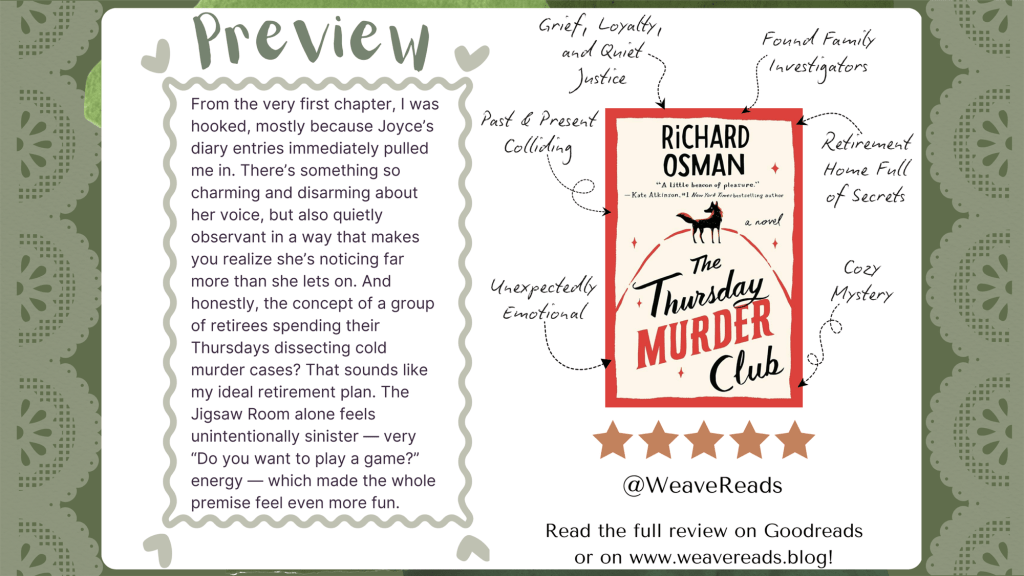
From the very first chapter, I was hooked, mostly because Joyce’s diary entries immediately pulled me in. There’s something so charming and disarming about her voice, but also quietly observant in a way that makes you realize she’s noticing far more than she lets on. And honestly, the concept of a group of retirees spending their Thursdays dissecting cold murder cases? That sounds like my ideal retirement plan. The Jigsaw Room alone feels unintentionally sinister — very “Do you want to play a game?” energy — which made the whole premise feel even more fun.
One of my favorite aspects of this story is how often the older residents are underestimated. Society tends to write people off as they age, assuming they’re forgetful, harmless, or uninvolved; this book completely dismantles that assumption. Elizabeth, Joyce, Ron, and Ibrahim are constantly observing, connecting dots, and quietly staying several steps ahead of everyone else, including the police. There’s something incredibly satisfying about watching them use that invisibility to their advantage. They aren’t just solving a mystery, they’re reclaiming agency in a world that assumes they’ve lost it.
The found-family dynamic between the Murder Club members was easily one of the strongest emotional cores of the story. Their loyalty to one another, their quiet protectiveness, and the way they show up for each other — even when things get dangerous or painful — made the mystery feel grounded in something much deeper than just a “whodunit.” The relationships, especially Elizabeth’s devotion to Penny and Joyce’s growing confidence and sense of purpose, added so much emotional weight.
And the mystery itself genuinely surprised me. Every time I thought I had a clear suspect or understood what was happening, the narrative shifted just enough to make me question everything again. New layers of the past slowly surfaced, secrets intertwined, and what initially seemed like a straightforward murder unraveled into something far more complex and human. Nothing felt cheap or random. Every reveal added meaning to what came before it.
What surprised me most was how well the alternating perspectives worked. Normally that structure can feel disjointed, but here it made the world feel interconnected. Each character offered a piece of the larger puzzle, and together they formed a complete picture: one built on memory, grief, justice, and loyalty.
Ultimately, this wasn’t just a murder mystery. It was a story about aging, friendship, loss, and the quiet strength people carry with them long after the world stops paying attention. It balanced humor, heart, and suspense beautifully, and I found myself completely invested in these characters.
I loved this story. It was clever, heartfelt, and genuinely unique — and I already miss spending time with the Murder Club.
 WeaveReads
Leave a comment