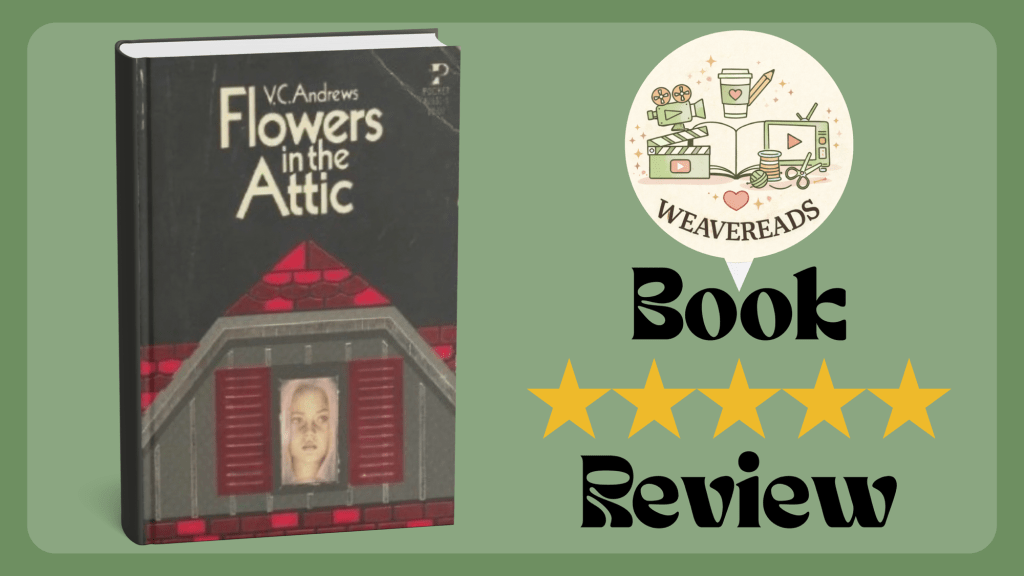
I made the mistake (in my opinion) of starting this book with the foreword by Gillian Flynn, which offers more insight into the novel’s themes and character dynamics than I would have preferred going in. If you’re someone who enjoys experiencing a story as blindly as possible, I would actually recommend skipping it.
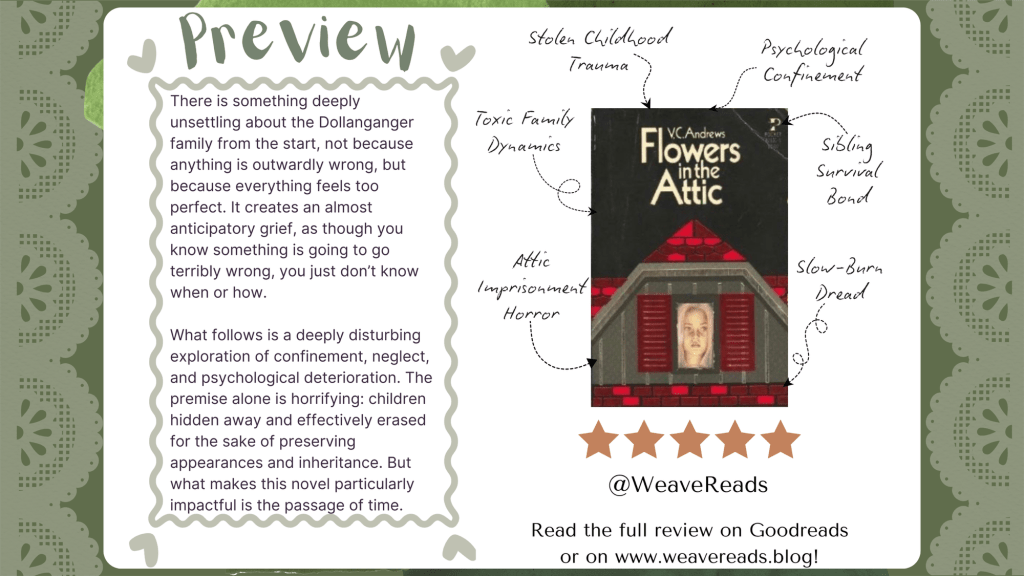
That said, once I moved into the prologue, I was immediately drawn in and filled with a sense of dread. There is something deeply unsettling about the Dollanganger family from the start, not because anything is outwardly wrong, but because everything feels too perfect. It creates an almost anticipatory grief, as though you know something is going to go terribly wrong, you just don’t know when or how.
What follows is a deeply disturbing exploration of confinement, neglect, and psychological deterioration. The premise alone is horrifying: children hidden away and effectively erased for the sake of preserving appearances and inheritance. But what makes this novel particularly impactful is the passage of time. Months turn into years, and with that, we witness not just physical deprivation, but emotional and developmental loss. Childhood is not simply interrupted, it’s taken.
Cathy, as a narrator, becomes the emotional anchor of the story. Her gradual awareness of their situation — and her growing understanding of what they are being denied — is heartbreaking. She is forced into a role far beyond her years, acting as a caregiver and stabilizing force for her siblings, all while receiving little protection or reassurance herself. Her frustration, confusion, and resilience feel incredibly grounded and human.
Chris, too, carries an impossible burden, stepping into a quasi-parental role without guidance, particularly as both he and Cathy begin to navigate adolescence in complete isolation. The absence of appropriate parental figures is felt in every aspect of their development, and the novel does not shy away from the uncomfortable consequences of that absence.
And then there is Corrine. It is difficult to articulate the level of anger this character inspired in me. While the grandmother’s cruelty is overt and brutal, Corrine’s betrayal feels more insidious. Her neglect is not passive; it is active, deliberate, and self-serving. Her increasing absence, emotional manipulation, and ultimate prioritization of her own comfort over her children’s survival made her, in my view, one of the most infuriating antagonists I’ve encountered in fiction.
The turning point involving Cory was particularly devastating. By that stage, the novel had already established a pattern of cruelty and neglect, but this moment shifts it into something even darker. The revelation of arsenic poisoning reframes everything that came before it, transforming what might have been perceived as neglect into something far more calculated and unforgivable.
By the final act, I found myself reading with a mix of urgency and anger; completely absorbed, yet deeply unsettled. This is not an easy book to read, nor is it meant to be. It is uncomfortable, often upsetting, and at times infuriating. And yet, it is undeniably compelling.
A deeply unsettling but entirely gripping read — 5 stars.
 WeaveReads
Leave a comment