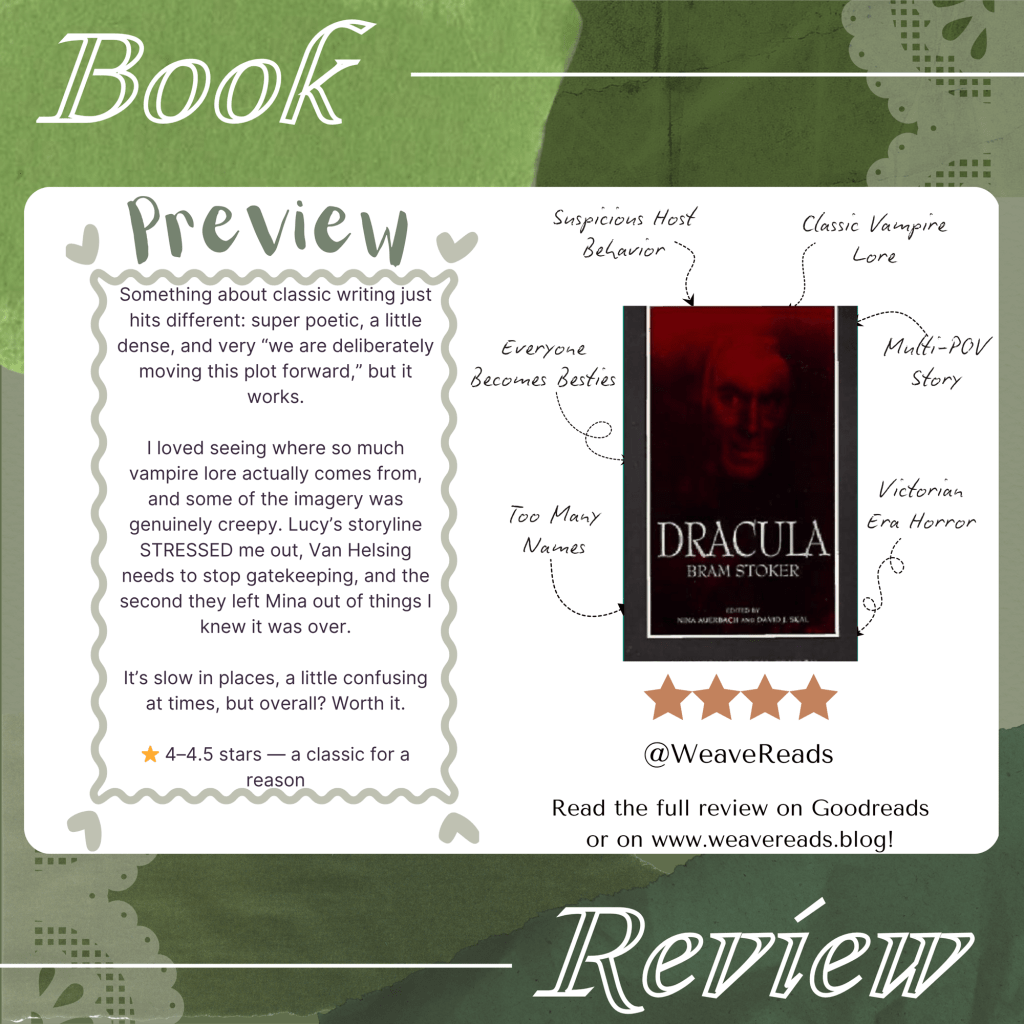
There’s something about classic novels that just feels different. Dracula has that dense, almost poetic narration where dialogue comes in these big, blocky paragraphs and everything feels intentional, like the characters themselves are aware they’re moving the story forward. It’s not my favorite style to read all the time, but I really appreciated it here. It gives the story a weight that modern writing doesn’t always have.
Also, I couldn’t help but notice how very of its time the setup is; someone gets a suspicious letter, travels for days to investigate, and just commits. That kind of slow-burn, curiosity-driven plot doesn’t really exist the same way anymore, and it was fun to experience. (A modern example off the top of my head is “Mexican Gothic.”)
It was also really interesting seeing the foundation of so much vampire lore, like Dracula not appearing in mirrors. It’s one of those things that feels obvious now, but realizing this is where it came from made it hit differently.
That said, I did struggle a bit with the constant introduction of names, places, and lineages. Older novels love to do that, and while I get that it adds depth, it can feel overwhelming when it doesn’t all seem immediately relevant. I definitely had moments where I was like, “Okay… do I need to remember this?”
The structure — switching between Jonathan’s experiences and Seward’s entries — also confused me at first, but once everything clicked into place (especially with Lucy and Mina), I really started to enjoy how the perspectives built on each other. The Captain’s log entries were especially eerie, and some of the imagery (like Dracula “sleeping”) was genuinely unsettling.
Lucy’s storyline stressed me out so much. Watching the men handle her situation — while clearly not saying what’s actually going on — was frustrating in that very classic “men underestimating women” way. And Van Helsing speaking in riddles instead of just saying “hey, we’re dealing with a vampire” drove me insane.
But the payoff was definitely worth it. The reveal with Lucy was genuinely satisfying, and once all the characters came together I liked the sense of unity, even if it did mostly consist of them compiling notes and reacting for a while. And of course, leaving Mina out of it entirely was a choice… one that immediately backfired.
By the end, I felt like so much had happened; the pacing still felt slow in places, but not in a bad way. More like a steady unraveling. Overall, this was a really enjoyable read. Atmospheric, foundational, and honestly more dramatic than I expected.
4-4.5 stars. A classic for a reason, and definitely a must-read.
 WeaveReads
Leave a comment